Capstone Design project-Device for 3d printer air pollution
- Seunghye Baek

- Mar 3, 2020
- 3 min read
Updated: Mar 4, 2020
period: 2017.06~2017.12
team: environuts(Seung-hye Baek, min-seok Yang, Gyu-yul Im, Gyun-joo Lee)
Product: Canop-nuts
Mentor: Myong-Hwa Lee, Ph.D
Indoor air pollution
These days, people work inside of buildings rather than outside. So indoor air pollution reveals its importance more than past. Air pollution is one of the world’s largest environmental risk to health; 7 million people across the world die each year as a result of everyday exposure to poor air quality. Who is affected depends on exposure and occupation. In some countries, simply preparing a meal is a major risk to health because of indoor air pollution with 4.3 million deaths attributed to household air pollution.(United Nations Environment Assembly(2016), Healthy Environment, Healthy People, pp.3~4)

3d printer-prospects and problem
3d printer refers a device which is used to create 3 dimensional object.
The 3D printing market is expected to grow at a CAGR of 25.76% between 2017 and 2023, to be worth USD 32.78 billion by 2023 with Aerospace and Defense, Engineering, and Healthcare to hold large share of market while 3D Printing Industry Led by North America region with largest share.
However, there is a huge problem in 3d printer. It causes indoor air pollution.
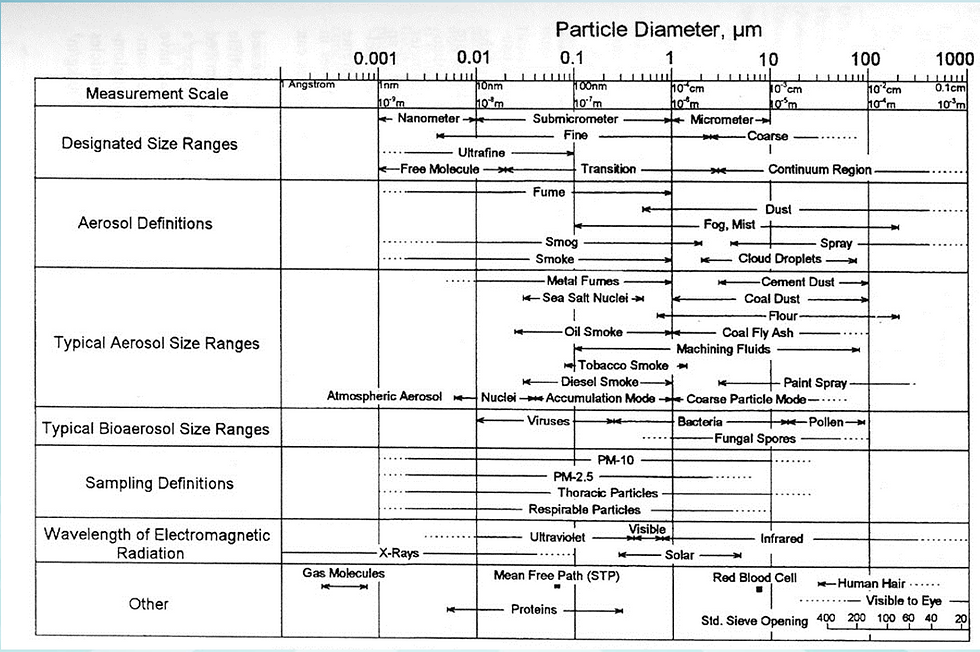
3d printer melts filament at the very high temperature(around 200 celcius). This process generates UFP and VOCs.
Our team, Environuts focused on ABS filament. ABS, short term for Acylonitrile Butadiene Styrene, is an oil-based plastic. It is a strong, sturdy material that businesses widely use for constructing things such as plastic car parts, musical instruments, and the ever-popular Lego building blocks. Even though this material brings high quality product it can be degraded into hazardous gas(especially, styrene) and UFP at high temperature.
Therefore, we are designing purification device for 3d printer which can remove both VOCs and UFP.
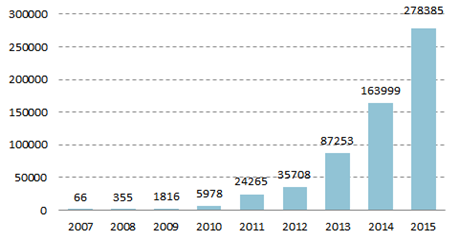
Wohlers Report, 2016. Desktop 3d printer rate of sale in US
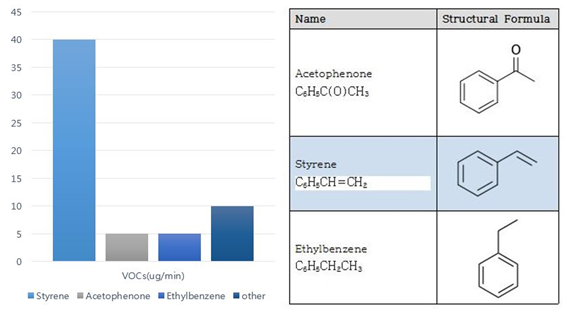
Styrene is one of the carcinogen VOCs which has no threshold dose for human health.
UFP and VOCs have the potential to cause severe disease. Such as respiratory diseases (including asthma and changes in lung function), cardiovascular diseases, adverse pregnancy outcomes (such as preterm birth), and even death.
(Air pollution, [online] Available at: https://www.niehs.nih.gov/health/topics/agents/air-pollution/index.cfm [Accessed 13 DEC. 2017])
Marketing analysis
1. 3d printer History

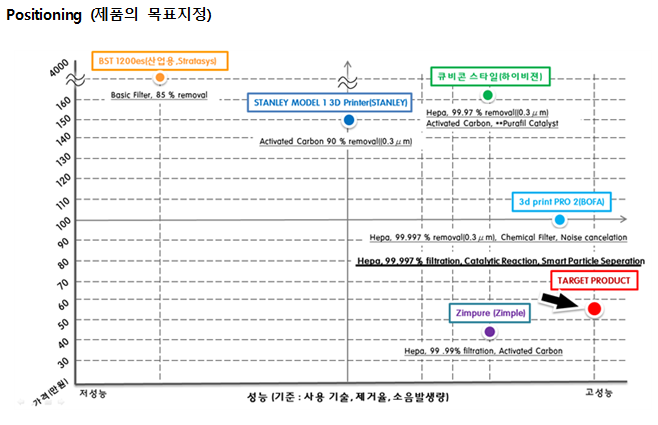
2. Competing product analysis
(There is no specific purifying device for 3d printer in Korea 3d printer market, so we searched abroad products.)



Product designing
While closed 3d printer system is working, flow of heated gas and particles go to the upper level due to low density. So we planned to design canopy type suction head and install it on the top of the 3d printer. Body part is composed of 3 filters; HEPA filter, catalystic activated carbon filter and again HEPA filter(to capture flying carbon particles).
Active carbon can absorb VOCs. And HEPA filter has efficiency of 99.97% at 0.3 microns and 99.5% at0.003 microns.
(HEPA filter is already commercialized in CUBICON COMPANY-3d printer company)
For the optimal efficiency, the filter is pleated ( not a flat surface). This also decrease pressure drop(caused by dust clogging) and energy consumption.
But need to be careful not to make high dead space. (If the pleated angle is too small)
We selected triangular pleats rather than rectangular pleats. In the case of rectangular pleats, increasing pleat height would increase pressure drop rapidly. However, for triangular pleats, increasing height reduce the pressure drop.(Chang Ming Tsang, 1997, ANALYSIS OF PLEATED AIR FILTERS USING COMPUTATIONAL FLUID DYNAMICS ,83p)


The purification process of device is shown below. Polluted air goes through PM2.5 filter, HEPA filter, catalytic activated carbon filter and HEPA filter again to catch fly dusts. The fan in the back sucks air.


VOCs, UFP detector circuit

Argorithm

Capstone design project poster



Comments